Saturday, December 19, 2009


What science ideas did you learn?

This week in science we learned Newton's third law (Every action has an equal and opposite reaction).

How did you learn these ideas?

We learned this week that Newton's law is that very action has has an equal and opposite reaction. We learned this by seeing Cathy and Laura sit on two different carts facing each other. Cathy then put her feet on Laura's knees and pushed Laura as hard as she could. But not only Laura moved when Cathy pushed her, but Cathy moved too. This shows that Laura also pushed Cathy, as Cathy pushed Laura. This proved to us that Newton's third law is true.

What real world application is there?

This video I found shows some examples of Newton's third law

Saturday, December 12, 2009


What science ideas did you learn?

This week in science class we learned about peoples weight on the moon and in a elevator. We also talked about why the moon has less pull than the earth.

How did you learn these ideas?

If you were to enter an elevator and stand on a scale, then have the elevator start moving up. You would see that your weight went up. If the elevator then started to move down, your weight would decrease. If the elevator moved at a steady rate and then stopped, your weight would remain unchanged. We also learned that the moon has less of a pull than earth. this is because it is less massive. We learned that the more mass an object has,the less the acceleration it has. Also that the greater the force on an object, the greater the acceleration.

What real world application is there?

If you saw that there was a man pushing a chair across the floor, You would know that a force diagram for this situation would look like this.


Friday, December 4, 2009


What science ideas did you learn?

This week we learned how to make force diagrams for different situations. Such as a man holding a basketball, or Mr. Finley dragging Adytia across the ground. We learned that all objects can generate force. We also got to go outside and push Mr. Finley's car as an experiment.

How did you learn these ideas?

For the question/situation of a  man holding a basketball, here is a picture, force diagram, and a Number sentence.  The man is able to hold the basketball stationary because the force of the hand on the ball is equal to the force of the hand on the ball.

For the situation of Mr. Finley Dragging Adytia across the ground, here is a picture, number sentence, and force diagram. Mr. was able to drag Adytia across the floor because he generated more force than the force of the surface of the floor on him. The force of the floor on Adytia and the force of the earth on Adytia equaled each other and did not effect Mr. Finley's ability to drag Adytia.

What real world application is there?

I thought of two real world ideas about force. These are bowling, and tug of war. If you are bowling, you would need the force you give to the ball to be greater than the force of the surface of the ground to be able to reach the pins. In tug of war, both sides have the same force of the earth and force of the ground on them. The force of the strongest team will decide who is the winner.

Sunday, November 22, 2009


What science ideas did you learn?
We learned how to make the different types of motion diagrams.

How did you learn these ideas?
You can create a motion diagram for almost every situation. For example, if a man was jogging down at a steady pace from the start. but eventually got tired and slowed down, the diagram would look like this.

Or, if a bungee jumper jumped off a bridge, it would look like this.

What real world application is there? 

A car starting at a red light moves at a steady pace and approaches, then passes through a yellow light.

Thursday, November 5, 2009


What science ideas did you learn?
  • We learned how to find slope
  • How to use variables to represent time and position, or how fast something or someone is going.


How did you learn these ideas? 

  • You find slope by dividing the vertical change by the horizontal change. Here is an example of what slope may look like.
5
_______           position over time

1
What real world application is there?

Slope affects me as a snowboarder because the the colors of the hill(Green circle-easiest, Blue square-difficult, black diamond-very difficult, double black diamond-extremely difficult, orange rectangle-freestyle). The difficulty of the hill is probably scientifically found by using slope.


Sunday, November 1, 2009

Science


What Science ideas did I learn?

  • Physical quantities
  • Making graphs, tables, and dot diagrams
  • Used a machine that measured distance

How did I learn these ideas?

  • We learned that a physical quantity is any unit of measure. For example, inches, quarts, pounds, miles, degrees, seconds, hours, celsius, kilometers, grams, kilograms, etc.

  • This week we learned how to and made many graphs, table, and dot diagrams of different things we saw, such as Mr. Segen walking across the room. In the pictures bellow are some examples of what some of the dot diagrams, tables, and graphs, may have looked like.
  • On Friday we got to use the machines that measured time and distance. You could aim it at someone or something moving and when the time was up it would create a graph of the distance the thing was from it at specific time. It not only did that, but it could combine any graphs it recorded into one graph. The experiment my group did was that Andrew would run close to it and then away and then repeat it until it stopped recording. The graph we recorded was very interesting. It looked like this.

Saturday, October 24, 2009


What science ideas did you learn?

1.We tested to find out which is more helpful, north, south, east, and west or right and left.

2.We also tried to find different ways to communicate direction. (Other than north, south, east, and west and right and left.)

3. We wanted to find out how the motorized car traveled. Did it speed up as it drove, slow down, or keep a steady pace?

How did you learn these ideas?

1. Which is more helpful, north, south, east, and west, or right and left? We tested this by first getting a partner. Then we faced each other and pointed left. Then we faced the front of the class and pointed left. When we faced the front of the class we both pointed in the same direction, but when we faced each other and pointed left, we were pointing in different directions. Then we faced each other again but this time pointed west. After that we faced the front of the class and pointed west. When we did that, we were pointing the same direction both times. This let me conclude that north, south, east, and west is more useful for using direction than pointing left or right.

2. What other ways can you communicate direction? (other than N,S,E, and W or right and left). In class we came up with a different way to use direction. We used the idea of a coordinate grid. One direction was X, left horizontally, and Y, vertically or up and down. We also used positive and negative to use direction.


In the picture above, the person is moving in the X positive(X+) direction.

3. Last, does the motorized car speed up as it travels, slow down, or keep a steady pace?  We tested this by letting the car start going at a specific point. Then, after every second, draw a line in front of the car. After four seconds, we measured the space between each line. The bigger space per second the faster the car was moving. The smaller the space between each line, the slower the car moved. these are our results- Second 1=30 inches, second 2=19 1/2 inches, second 3=20 inches, and second four=22 1/2 inches. This led me to conclude that the car sped up for a short time, but then slowed to a steady pace.

What real world application is there?

If you have seen an accident and are giving a police report, or are explaining to a 911 operator were you are, it would be much more helpful to use North, South, East, and West, rather that right and left. If you use compass directions you could give a very helpful police report, or have 911 find you easily. With right and left there would be to much of, " My right, or your right?". The police need me to tell them " I am on the west bound lane of interstate 78" or, "The car was traveling west through he intersection".

Monday, October 19, 2009

Week of the 10/12 through 10/16

What science ideas did you learn?

This week we learned about opaque. translucent, and transparent surfaces. We also learned and tested how light is like a slinky. Last, we found out how a laser would shine when shown into a triangular prism.

How did I learn these ideas?

Opaque Surface- If a surface is opaque, light cannot pass through and it must reflect off. 
Examples- Table, wall, and wood.
Translucent Surface- If a surface is translucent, some light is able to pass through it, or 
refract, and some reflects. Examples- Paper, tinted windows.
Transparent Surface- If a surface is transparent, most or all of the light is able to pass 
through it. Examples- Water, Glass.
Slinkies and Light- We tested how light was like a slinky. We did this by connecting a thick 
slinky to represent water or glass, and a thin slinky to represent air. When we put a wave 
through the thin slinky first, then through the thick slinky, the wave started fast and big. When 
it hit the thick slinky, it got smaller and slowed down. When we reversed the experiment and 
started the wave with the thick slinky and then through the thin slinky, the wave was small and 
slow, but sped up and got bigger when it hit the thin one. We also noticed that the main wave 
would carry through the whole slinky combination, but a smaller one would stoop half way and 
bounce back to the start. This happened in both experiments. This demonstrated how light is 
like a slinky because the wave in the slinky traveled the same from thick to thin, as light waves
would travel from water to air. The reverse is also true.
What happens when a laser is shined into a triangular prism?- When the laser shined 
through he triangular prism, the beam bounced off of the sides of the glass and back to where it 
entered. 

What real world application is there?

Sunglasses are an excellent example of how light travels through translucent surfaces. By 
limiting the amount of light that can refract through the lens, sunglasses protect our eyes from 
dangerous and uncomfortable amounts of sunlight.


Thursday, October 8, 2009

Light waves


What Science ideas did you learn? 

We learned about Newton's and Huygen's ideas about light. Newton believed that light is made up of particles and moves in rays. Huygens believed that light is made up of waves, such as the ripples you see in water when it is moved by and object. We also came up with the idea that light has no weight.

How did you learn these ideas?

We tested Christiaan Huygen's idea that light travels in waves. First, we put Mr. Seagens laptop very close to the projector, studied the shadow and took notes on what we saw. Next, we put the laptop very  close to the  wall with the projector shining on it. We then studied that shadow and took notes on what we observed. When we put the laptop close to the projector, the shadow was very big, but had blurry edges. When we put the laptop close to the wall, the shadow was about the same size as the actual laptop and also had a much cleaner edge than the shadow when the laptop was close to the projector. We tested this again by putting a block in the middle of a sink filled with water. We then dropped water next to it to see how the ripples reacted when they hit the block. The water block would serve as the light source,  the block as the laptop, and the ripples in the water as the light waves. the ripples seemed to split as they hit the block and bounced off of everything they hit. Next we tested the idea that light has no mass. We tested this by shining a flashlight onto a scale. We set the scale to it's most sensitive setting and shined the flashlight onto it. The scale showed no change in weight so we concluded that light has no mass.

What real world application is there?

A camera is a great example of how we use our understanding that light travels in rays instead of waves. In the article "How does a camera work?" in Yes Mag science magazine written by Stephen Whitt, he gives a great explanation f how a camera works.

"One kind of camera — which can be either a digital camera or a traditional film camera — is called a single-lens reflex (SLR) camera. In this camera, there is only a single set of lenses for both viewing and photographing an image. Let’s say you spot your dolphin and lift your camera to your eye. What happens?

First, light bouncing off the dolphin passes into the camera, through a set of lenses, and onto a mirror. From there, the light bounces up and into a funny-shaped piece of glass called a pentaprism (penta means five, and the pentaprism has, you guessed it, five sides). Once light enters the pentaprism, it bounces around in a complicated way until it passes through the eyepiece and enters your eye.

The dolphin is swimming just below the water, but you have a feeling it’s about to surface. Wait for it, wait for it…there! You snap the picture. When you press the button on the camera, the mirror flips up out of the way. Instead of bouncing into the pentaprism, light from the dolphin passes directly to the back of the camera. There, it either hits photographic film and starts a chemical reaction, or else it impacts an array of light-sensitive cells that release a tiny electric charge in each activated cell. Either way, even though the dolphin’s long gone, you’ve captured its image. Congratulations!"

If light traveled in waves, the technology used by a camera would be completely different.


Saturday, October 3, 2009

10/2 How light rays travel


What science ideas did you learn?

This week we covered many ideas of how light rays travel.  First of all, we wanted to know how light travels.  We came up with 5 ideas to test this.  Secondly, we wanted to find out if something had high or low focus.  Thirdly, we needed to find the angles at which the light bounced off a mirror. The first angle we wanted to find was called 'angle A' or the 'angle of incidence'.  The second angle we wanted to find was called 'angel B' or the 'angle of reflection'.  As an extra, my group wanted to know what made the laser reflect off the water.  We wanted to know if the water reflected the laser, the pan reflected the laser, or if it was a combination of the two.  

How did you learn these ideas?

1.  How does light travel?  We were able to eliminate 3 of the 5 hypothesis of how light travels in class.  We were able to eliminate hypothesis A because light does not travel backwards.  By shining the laser on a mirror at an angle, the light bounced off at an angle except when the laser was pointed straight in the mirror.  Next we eliminated hypothesis C, that a light ray stays intact as it travels, because if it were true, everything we see would be doubled, tripled, or quadrupled.  Finally, we eliminated hypothesis D, which was a larger scale version of C.  Hypothesis B and E were left.  Hypothesis B is that one ray of light hits and object and bounces into our eye as one ray.  Hypothesis E is that millions of rays hit an object and bounce into our eye.  I believe hypothesis E is correct because with hypothesis B, we would only see one very small point of the object. With hypothesis E, the millions of rays would work together to make a complete image for my eye to see.  

2. High Focus vs. Low Focus.  We also tested if certain objects had high focus or low focus.  We did this by seeing how reflective, or clear, certain objects are by shining the laser at them.  The more clear, or reflective, of the laser, the higher the focus.  The less reflective objects would be low focus.  Examples of high focus items such as glass, mirrors, water, or clear plastic.  Low focus items include wooden desks, pieces of paper, the wall, and clothing.

3. Measuring angles of light.  We tested what angle the laser pointer bounced by using a mirror, a laser pointer, two erasers, and a protractor.  First, we laid the mirror face up on the table and clapped the erasers over the mirror to create dust.  The dust allowed us to see the laser path.  We shone the laser at different angles and used the protractor to measure the angle of incidence, angle A, and the angle of reflection, angle B.  Lastly, we recorded the measurements in our notebook and repeated the process 9 more times.  I expected that angle A would be the same as angle B, but in our experiment this was not true.  

4.  Water reflection.  We tested this by shining the laser pointer in the clear, plastic pan when it was empty and dry.  The laser reflected off the pan onto the ceiling.  Then, we made a puddle of water on the table (a low focus object) and reflected the laser off the puddle.  It also reflected off the puddle and onto the ceiling.  When we added water to the pan, it made two dots on the ceiling in different spots.  One was large and fuzzy, and the other was smaller and clearer.  I think this is because some of the rays hit the surface of the water and bounced directly onto the ceiling creating the small clear dot.  Other light rays traveled further, through the water, and reflected off the bottom of the pan.  If the water wasn't perfectly still, the rays may have changed direction somewhat as they reflected off the bottom of the pan and up through the surface of the water.  This would explain the larger, less clear spot.  

Saturday, September 26, 2009

How do light rays travel?

What science ideas did you learn?

This week we learned a lot of science ideas. First we wanted to find out how we could see a marker. Does the light hit our eyes and then the marker, does the light hit the marker and then reflect into our eyes, or does light have nothing to do with it at all and we can just see the marker. Next we wanted to find out why when the candle light went through the small hole, it showed up on the wall upside down. Then, when the light went through the hole bigger than the flame, the spot on the wall was the shape of the bigger hole. Last, we wanted to find out why when we shined the laser pointer on a mirror, the dot on the mirror was extremely small, but the reflected dot on the wall was much bigger than usual.

How did you learn these ideas?

We immediately were able to cross off the idea that light had nothing to do with us seeing the marker.  We already did an experiment to test if we could see without light, and none of us could.  We couldn't quite think of a way to test the other hypotheses of how we could see the marker.  Our hypothesis for the candle light going through the hole in the cardboard was that the light rays cross.  The top rays go down, and the bottom rays shine up.  This is why the reflection on the wall appears upside down.   We wanted to know if the light rays crossed before or after the hole in the cardboard.  We tested this by having someone slide their finger in front of the hole to see what affect the shadow had on the reflection.  (see illustration)  Since the reflection of the candle flame was upside down, we could tell at what point the light rays crossed.

Why is it important to know this idea (What real world application is there)? 

It is important to understand how light rays travel and reflect on objects enabling us to see images.  If we didn't understand this, important technology we use every day would not exist.  The microscope works by shining an intense light through a small object into an objective lens which is magnified by the ocular lens so we see the object clearly.  The microscope allows us to see organisms smaller than our eyes could see, such as bacteria or paramecium.  Science and medicine would not be the same without the microscope.

Another important technology using our understanding of how we see is the telescope.  Unlike the microscope which has its own light source, the telescope works by gathering its light from dim, far away objects with a very large objective lens.  We use telescopes, like the Hubbell telescope, to explore objects in deep space otherwise invisible to us.  

Friday, September 18, 2009

Light

What science ideas did you learn?

I learned that air particles could either be invisible and not reflect the laser pointer, or the air particles could reflect but be too small for our eyes to see the reflection. I also learned that there may be one  ray of light coming from one point on a light bulb, or millions of rays coming from one point on a light bulb. I believe that there are millions of rays coming from one spot making it seem as if it were one big ray. We also had the ideas that you either could not see in the dark, or that your eyes would eventually adjust.

How did you learn these ideas?

I learned these ideas in many ways. I learned them in class discussion, my table, my own observations, and from experiments. For example, the experiment whether you can or can't see without light. We tested it by covering a side of Mr. Finley's desk with a black sheet, turned off all the lights, and put a sign on the inside of the desk. Then we went inside and tried to read the sign. No ones eyes could adjust and no one could read the sign. This led me to believe that there must be a small amount of light to reflect into my eye to allow me to see. 
In the laser pointer experiment we sprinkled chalk and flour above the laser to let us see the laser. The particles of flour and chalk reflected the light from the laser into our eyes enabling us to see the laser beam that was invisible to our eyes before. I concluded that air particles do reflect light but are too small for us to be able to see the reflected light.

Why is it important to know this idea?

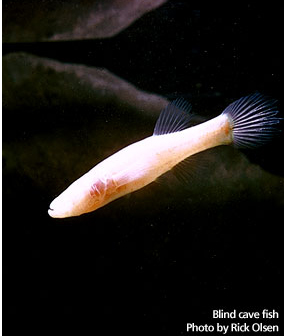
It is important to understand how our eyes work. If there is no light to reflect in my eyes, then I can not see. This is important to understand because if injury or disease damage the reflecting lenses in my eyes i would end up blind.  I also understand why it would be important to take a light source into situations without natural light such as deep sea and deep cave explorations. This also explains to me why some animals living in these environments have no eyes or have lost the use of their eyes.

Click on the link below to view a national geographic article about a cave  fish that lost the use of it's eyes:


Saturday, May 30, 2009

This week in science class

Monday: We had no school on Monday Because it was Memorial Day.

Tuesday: On Tuesday the documentary group had to finish watching the documentaries and taking notes. The classifications group/ Carolus Linneus group also had to finish. I was in the documentary group. I learned about all of the relatives of humans or hominids.

Wednesday: On Wednesday we switched groups. Now I was in the classification group/ Carolus Lineus group.  We learned about Carolus Lineus, Classification, and bionemalnomenclature, the art of classification. We also learned that Carolus Linneus' real name was Carol Linne. He changed his name to Latin which is also what he did to name his classification groups. For example, he changed animals to animelia.

Thursday: We had to complete the Carolus Linneus packet by Friday.

Friday: We discussed the packet that we did on Carolus Linneus with the class. Then we had a two minute discussion on food chains/food webs. Last, we had to watch videos about when it was illegal to teach about evolution in public schools. For homework we had to blog.

Saturday, May 23, 2009

This Week In Science Class

This week in science, we learned a lot.  We learned about Gene Flow, Genetic Drift, The Lamarkian Theory of Evolution, The Darwinian Theory of Evolution, Mutation, Genetic Engineering, Selective Breeding or Unnatural Selection, and About hominids.  Gene Flow is Change in a population through migration.  For example, say a bunch of people from Australia go to India.  Then they will have children.  This causes the change in population through migration. Genetic Drift is a change in a population because of chance.  There are a bunch of red bugs and black bugs in the grass.  The only difference between the bugs is the color.  Then a random tree falls and kills all of the red bugs.  Neither of the bugs had a better or worse chance of survival. This is why it is a change in population because of chance.  The Lamarkian Theory of Evolution is that if you try really hard to do something, eventually in your lifetime, it will happen.  Then if your mate has done the same, your children will be born with that trait.  But, if you don't use it it will slowly shrink and eventually disappear.   For example, this is saying that if a man and woman work out a lot and try hard to get big muscles, eventually in their lifetime, they will get it.  And if they get married and have kids, their children will be born with big muscles.  The Darwinian Theory of Evolution is that even if you and your husband/wife work out for a few years, your children will be born with the traits that you originally started out with, and they will have to work just as hard as you to become as strong.  A mutation is a sudden, random change in the DNA of the being.  It can be good or bad for the animal.  Genetic Engineering is genetically changing the DNA of an animal.  Selective Breeding, or Unnatural Selection, is humans choosing the trait that they like best in an animal and only breeding the ones they like best.  We also learned about hominids.  Hominids are the ancestor/relatives of humans and primates.  They are also known as great apes.  They are large, tailless and omnivorous, which means they eat meat and plants.  They were also the first group of organisms to walk upright.  Humans did not evolve from the primates of today.  But, the closest organism to humans is the chimpanzee.  This does not mean that all chimpanzee's will evolve into humans.  Africa was the first continent to hold life of hominids.  Last, on Friday we took a quiz on Gene Flow, Genetic Drift, The Lamarkian Theory of Evolution, The Darwinian Theory of Evolution, and mutations.

Friday, May 15, 2009

This week in science

We learned about Evolution, Natural Selection, Adaption, and mutation this week. As an example we used Iguanas and how they evolved over time. All eguanas came from the sam iguana. Then they naturaly moved to different types of land such as forests, land, and marine iguanas. Then, over many generations, they evolve to best suit their environment. Last on Friday we took a quiz on Evolution, Natural Selection, Adaptation, and about mutations. For homework we had to blog.

Sunday, May 10, 2009

This week in science class

Monday:  We wrote down notes about adaptation.  We learned that it occurs over many generations, so that the being will better suit it's environment.

Tuesday:  I was not at school on Tuesday because I had a bad cold.

Wednesday:  Also, I was not in school on Wednesday, because I was still sick with the bad cold I had on Tuesday.

Thursday:  We talked about what we did on Tuesday and Wednesday.

Friday: I was also confused on Friday because we went over what we did on Tuesday and Wednesday again.

Sunday, April 26, 2009

Cockroach Experiment

We did an experiment this week about cockroaches.  On the first day we observed them walking on our table. Then we came up with questions we could answer about them.  My table chose my idea. My idea was, "Which colors do cockroaches prefer?".  We had two dark colored sheets of construction paper, black and brown, and two lighter colored sheets of construction paper.  We placed all four colors in a shoe box.  We then got four different cockroaches and tested them each four times, facing a different color each time.  We gave each cockroach a time limit of ten  seconds. We then recorded which color they were on at the end of the time limit.  At the end of our experiment, we discovered that cockroaches prefer darker colors, mostly black.  The cockroaches went to either black or brown eleven out of sixteen times.  They went to black half of the time, or eight out of sixteen times.  We then made a slideshow presentation of our prediction, Hypothesis, materials, procedure, results, and our conclusion.  Then, we presented on Friday.  For homework on Friday we had to blog.

Wednesday, April 8, 2009

Camp Spears Trip

At Camp Spears I learned a lot about science.  I learned that lentic water is the scientific term for still water.  Also that the scientific term for moving water is lotic.  I learned that there is a type of bug called a dragonfly nymph, which is a really weird looking bug that eventually turns into a dragonfly.  We learned about vertebrates, which are animals with a spine such as a fish, and about invertebrates, which are animals without a spine such as a worm.  I found out that there is a chemical that comes out of a certain tree that gets into the bog which allows anything that is inside of the water can be preserved forever.

Saturday, April 4, 2009


This week in science,

On Monday, We worked on finishing our reebop projects.  Then, I got a bad cold and was absent on Tuesday.  I heard from my friends that we worked on our projects again, and turned them in at the end of the day.  Then, on Wednesday, We learned what an observation is.  An observation is something that we see, or all of our senses except for taste.  It can also be microscopic, or macroscopic.  You also need drawings, background info, identify all patterns/trends, and to answer all questions.  We also started by observing cockroaches.  On Thursday, we took our test. Most people did not finish, so they had to finish on Friday.  Last, on Friday, we finished our tests, worked on our blogs, and made more observations on the cockroaches.

Monday, March 30, 2009

Genetic Variety

Genetic variety played a giant role in my reebop family! Genetic Variety is what makes everyone different. With genetic variety, nobody has the same genotypes and phenotypes. Phenotypes are your physical traits, which you can see, such as brown hair or blue eyes. Genotypes are your genes, which you can not see, such as being heterozygous, homozygous  recessive, or homozygous dominant for a trait. Thanks to genetic variety nobody looks the same, or has the same genes!
My P1, or first generation, reebops' genotypes were ll, Rr, GG, DD, WW, FC, XY, and SS. This means that its' phenotypes were, short legs, red eyes, a green body, dots, wings, curved and feathered antennas, was a boy, and had spikey legs. My F1 reebops' genotypes were, ll, RR, Gy, DD, WW, CF, XX, and Ss. This means that its' phenotypes were, short legs, red, eyes, a green body, it has dots,  it has wings, it has a curved and feathered antenna, is a girl, and has spikey legs. You may have noticed that both my P1 and F1, or first and second generation reebops, have the same phenotypes! This means they would look exactly the same! But, you also may have noticed that both of their genotypes are different. So, even though my P1 and F1, or first and second generation reebops, looked exactly the same, or had the same phenotype, they had different genes, or a different genotype. Then, something weird happened! my F2, or third generation, reebop had a yellow mutation! Its' genotypes were, LL, RR, yy, WW, dD, CC, XY, and Ss. This means that its' phenotype was, long legs, red eyes, a yellow body color mutation, wings, dots, curved not feathered antennas, is a boy, and  has spikey legs. This bug looks a lot different from my P1 and F1, or first and second  generation, reebops! How did this happen? With genetic variety I got genes from people I did not mate with. But, the person I mated with may have mated with someone with a yellow mutation. Then, my F3, or fourth generation, reebop. I think it is pretty ugly. its' genotypes were, Ll, RR, By, WW, dd, FC, XX, and ss. This means that its' phenotypes were long legs, red eyes, brown body color, wings, no dots, is a girl, and does not have spikey legs.
As you can see, my reebop changed a lot from my P1, or first generation, reebop to my F3, or fourth generation, reebop. I got lots of different gene combinations from not only the reebops my reebop mated with, but from all the people they mated with, and so on.  At the end of the project, I was related to over seven reebops! Even though, I only mated with three other reebops. This all happened because of genetic variety! This is why genetic variety played such a huge role in the making/creation of my reebop family!

Saturday, March 14, 2009


This week in science class!

On Monday we reviewed what we had learned about punnet squares. Then we learned about Co-Dominance and Di-hybrid cross. For example, with blood types, blood type A and blood type B are dominant. But blood type AB has both of the dominant blood types. This makes blood type AB Co-Dominant. The only recessive blood type is blood type O.

A= Dominant

B= Dominant

AB= Co-Dominant

O= Recessive

We also learned about positive and negative blood types. Positive is the Dominant and Negative is the recessive. 
A Di-Hybrid Cross is like a very big punnet square. Also, instead of only using one allele in each box at the top and left side, there is two alleles. With two alleles instead of one, you need a bigger punnet square which is why it is bigger. For homework we did the last of the sponge bob worksheets, worksheet number four.

Later on in the week we had to fix some things that were wrong with our blogger accounts. One of the problems was that if  you typed in your name on google , or any other search engine, your blogger account would show up. Lots of parents complained about this and then they blocked the website on all of the  school computers. We had to change our profile name from our full name to a nickname or one that we  made up. We also had to change our account so that none of the search engines like google could find our blogs. This is what we manly did all of Thursday and part of Friday. For the rest of Friday we started a project were we were each a bug with different traits. Then we would mate with another bug and see what the offspring of those two bugs would be.

Saturday, March 7, 2009

Monday: SNOWDAY!!!!!!!!!!!!!!!!!!!!!!!!!!!!!!!!!!!!!!!!!!!!!!!!!!!!!!!!!!!!!!!!!!!!!!!!!!!!!!!!!!!!!!!!!!!!!!!!!!!!!!!!!!!!!

Tuesday: We worked on the traits project by making a graph representing our classes results.

Wednesday: We compared the results of the traits of our class to the results of the whole grade. For homework we had to cut sperm and egg cell out of paper. The sperm cells were rectangle with a length of three inches and a width of one inch. The egg cells were a circle and had to be three inches in diameter.

Thursday: We put the sperm and egg cells into a cup and randomly picked out one of each and recorded our results. We also made a punnett square of what we thought would happen.

Friday: We checked if the results matched our punnett squares and recorded if they did or did not. Then we were going to take a quiz but we ran out of time and Mr. Finley E-mailed it to us to finish at home. For homework we had to take the quiz, write a paragraph conclusion about what we did in class, and blog.

Friday, February 27, 2009


Monday: We used blocks to go over meiosis.  The blocks represented homologous pairs, chromotids, and, chromosomes. Then we went over how the pea experiment related to meiosis. Then we fixed our hypothesis for homework.

Tuesday: We went over the pea soup experiment and tried to guess what the next four peas would be. We also tried to make the type of pea we wanted by using the alleles.

Wednesday: We did a little bit more with the pea experiment and went over the homework. Then we learned about punnet squares.  Also, we read in the text book and learned about heterozygous,  homozygous, dominant gene, and recessive gene.

Thursday: We had a long discussion about the homework and about punnet squares. Then we started on the lab but didn't get to do much of it. For homework we had to trace a gene back through three generations of our family.

Friday: We went over the homework and had a small discussion about it. Then we got into pairs and worked on a genetics sheet. We saw which traits each of us did or did not have. Then we had to type up the information on Microsoft excel. For homework we had to blog.

Sunday, February 1, 2009


Monday: We did a worksheet on mitosis. It showed all the steps of mitosis Prophase,  Prometaphase, Metaphase, Anaphase, and Telephase. We also learned the phases before and after mitosis. Interphase is before mitosis and cytokenesis is after mitosis. 

Tuesday: We did a review of mitosis and went over things we weren't sure on.

Wednesday: We had a snowday!!!!!!!!!!!!!!!!!!!!!!!!!!!!!!!

Thursday: We went around the room and each of us named an important term of mitosis. these terms were... Interphase, Cytokenesis, Anaphase, Metaphase, Telephase, Chromatin, Centromere, Spindle Fibers, Prometaphase, Chromosome, Centriole, Centrosome, Mitosis, Cell Reproduction, DNA, A-Sexual, Daughter Cell, Parent Cell, Sister Chromatid, Nucleic Membrane, Prophase, Cell Membrane, and DNA Replication.  For homework we had to make a concept map of these twenty three words.

Friday: We took a quiz on mitosis. It was multiple choice but you could not correct it. I thought it was pretty hard.

Sunday, January 25, 2009

Monday: We had no school!!!!!!!!!!!!!!!!!!!!!!!!!

Tuesday: We went over the study guide and answered any questions that we were confused on.

Wednesday: I went in early to review for the test.  I didn't eat breakfast so I could eat a donut, but when I got there everyone had eaten all the donuts:( During the review Mr.Finley went over the  questions that people had. Then in second period... I took the test. It wasn't as hard as I expected it to be.

Thursday: We talked about our new unit, cell reproduction. we learned that each a sperm and egg cell have 50%. We also learned that cheek cells are A-sexual which means that they can reproduce by themself.  They make new chromosomes(bundles of DNA) and then split and create a new cell.

Friday: We went onto the computers with a partner and did a worksheet and watched a video about mitosis.

Saturday, January 17, 2009

Monday: We talked about what we had left off on. We learned some words that we needed to know. We also voted on a date for the test
Tuesday: We learned about protein synthesis by doing a reenactment with people (ribosam and Stephen the Nucleus). It showed how the tRNA takes amino acids to the ribosome and then it turns them into a protein. Then the protein folds up.
Wednesday: We looked at root tips under a microscope and answered a worksheet about it. We looked at root tips and not the center of the root because the root is growing so there is lots of cells reproducing or splitting. Also for homework we had to study twenty five percent of the study guide and take notes
Thursday: We finished the rest of the worksheet and the talked about cell reproduction. Then we went over the the twenty five percent of the study guide that we did last night and took more notes on whatever we hadn't written down yet. For homework we had to study and take notes on fifty percent of the study guide.
Friday: We went over fifty percent of the study guide and wrote down what we did not write down yet. We talked about cell reproduction. For homework we had to study seventy five percent of the study guide and blog.

Monday, January 12, 2009

This Week in Science Class!!!

Monday: We had just gotten back from our Christmas break so we reviewed what we had talked about before the break and about protein synthesis and cell respiration.

Tuesday: We took lots of notes on photosynthesis and made....AN ENERGY PYRAMID!!! it showed how energy is transfered from plants.

Wednesday: It was an delayed opening because of snow so we did not have much time in class. We still made a... MICROSCOPIC PICTURE OF WATER!!!! We also learned what a calorie was.

Thursday: We had a sub so we did....LOTS OF CLASS WORK!!! We went onto a computer or laptop with a partner and did a double sided page about messenger RNA(mRNA) and transfer RNA(tRNA).
Friday: We took...A QUIZ!!!!!!!!!!