I learned that air particles could either be invisible and not reflect the laser pointer, or the air particles could reflect but be too small for our eyes to see the reflection. I also learned that there may be one ray of light coming from one point on a light bulb, or millions of rays coming from one point on a light bulb. I believe that there are millions of rays coming from one spot making it seem as if it were one big ray. We also had the ideas that you either could not see in the dark, or that your eyes would eventually adjust.
How did you learn these ideas?
I learned these ideas in many ways. I learned them in class discussion, my table, my own observations, and from experiments. For example, the experiment whether you can or can't see without light. We tested it by covering a side of Mr. Finley's desk with a black sheet, turned off all the lights, and put a sign on the inside of the desk. Then we went inside and tried to read the sign. No ones eyes could adjust and no one could read the sign. This led me to believe that there must be a small amount of light to reflect into my eye to allow me to see.
In the laser pointer experiment we sprinkled chalk and flour above the laser to let us see the laser. The particles of flour and chalk reflected the light from the laser into our eyes enabling us to see the laser beam that was invisible to our eyes before. I concluded that air particles do reflect light but are too small for us to be able to see the reflected light.
Why is it important to know this idea?
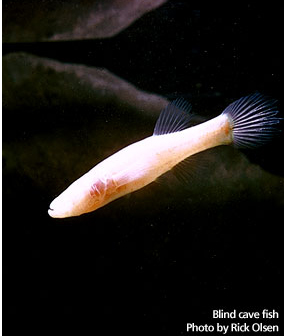
It is important to understand how our eyes work. If there is no light to reflect in my eyes, then I can not see. This is important to understand because if injury or disease damage the reflecting lenses in my eyes i would end up blind. I also understand why it would be important to take a light source into situations without natural light such as deep sea and deep cave explorations. This also explains to me why some animals living in these environments have no eyes or have lost the use of their eyes.
Click on the link below to view a national geographic article about a cave fish that lost the use of it's eyes:
No comments:
Post a Comment